When Thinking Becomes Optional in the Age of AI
Kate Kong, MA in Digital Studies '26

I only realized this a few days ago, when I was drafting this post:
my phone no longer has a dictionary app.
It’s not because my English has suddenly become flawless.
And it’s not because I consciously deleted them.
If anything, I used to be the kind of person who would download three or four dictionary apps at once.
Baidu Translation, Google Translation, multiple English–Chinese dictionaries…
I compared different explanations, checked if the translations matched, scrolled through examples, synonyms, antonyms—almost like solving a small linguistic puzzle.
That was my little “learning ritual,” the way I trained patience, precision, and curiosity.
But I genuinely don’t remember when I stopped doing that.
Maybe it was a late night before a deadline.
Maybe it was during a lecture when I didn’t understand a word.
Maybe it was the first time AI gave me an answer that was faster, cleaner, and somehow more “trustworthy” than the dictionaries I used to rely on.
All I know is that at some point, my muscle memory changed:
I no longer opened a dictionary.
I just asked AI.
At first, it felt harmless—just a tiny shift in habit.
But the moment I started thinking seriously about it, I felt something colder underneath—a mix of bitter amusement, fear, dependence, and uncomfortable clarity.
Because AI isn’t only translating words for me.
It’s giving me answers without effort:
I no longer need to read long articles,
or open multiple tabs,
or evaluate conflicting information,
or sit with confusion,
or search, wait, read, or reflect.
AI filters, summarizes, compresses, and delivers.
And I just take it.
Meanwhile, something in me has been quietly fading:
my patience,
my reading stamina,
my ability to synthesize from scattered fragments,
my habit of comparing sources,
my tolerance for long paragraphs,
my desire to wrestle with complexity.
The more convenient AI becomes, the more these old muscles shrink.
And in a strange way, all of this feels connected to the way our generation receives information now:
fragmented breaking news, thirty-second updates, constant notifications, algorithm-curated feeds.
We’ve been trained to skim, pick, scroll, extract—to live in speed mode.
AI didn’t create this rhythm.
It simply fits it perfectly.
But the real shock hits me in the classroom.
UChicago—especially the humanities—forces you to slow down.
We read original texts.
We dismantle arguments sentence by sentence.
We talk about assumptions, structures, contradictions.
We sit in the discomfort of not understanding immediately.
This “slow thinking” is the heart of the academic culture here.
And yet sometimes, even as I sit in class, I catch myself waiting—subconsciously—for the AI-style shortcut:
a simplified version,
a ready-made summary,
a neatly packaged explanation.
It scares me, honestly.
Not because AI will “replace” me,
but because I’m afraid I will slowly lose the depth of thinking that UChicago tries so hard to cultivate.
One afternoon at Regenstein, I stared at a 15-page reading for three full minutes—not because it was too difficult, but because my brain was quietly hoping for a faster way to digest it.
In that moment, I realized something unsettling:
AI isn’t just saving me time.
It’s reshaping how I approach knowledge—what I expect from learning, how long I’m willing to struggle with a text, and how quickly I want satisfaction.
And AI doesn’t stay in the classroom.
It’s everywhere in my grad student life.
When I write, it helps me untangle scattered thoughts.
When I read, it outlines structure so I know where to focus.
When I code, it feels like a patient partner.
When I prepare presentations, draft emails, or create content for my student ambassador role, AI is always the first place I turn.
But it also shows up in the smallest, most mundane things:
Which grocery stores in Hyde Park are still open after 8?
How many degrees Celsius is 375 Fahrenheit?
Is this word negative or neutral?
Is this sentence natural?
Why am I anxious today?
I throw all of it at AI.
Not because I can’t find the answers myself—
but because AI answers faster, cleaner, easier.
Some days, the convenience feels like a warm blanket.
Other days, it feels like a slippery slope.
I know the tradeoff: I’m exchanging depth for speed, patience for efficiency.
I tell myself “just this once,”
but “once” keeps happening.
That’s how I stopped using dictionaries.
Not out of intention—
but out of slow, silent habit decay.
So when I ask myself honestly:
Could I go back to my old self—the one who checked multiple dictionaries and read everything carefully?
Yes.
I could.
But do I want to?
No.
I don’t.
It’s like asking someone who’s used to 5G speeds to go back to 2G.
Technically possible.
Realistically unlikely.
Especially when waiting—loading, reading, processing—was once a part of how we built patience and understanding.
And that’s what scares me the most.
Not the technology itself,
but the part of me that no longer wants to go back.
Because if AI keeps doing the thinking for us, at what point do we stop noticing what we’ve quietly lost?
Patience?
Depth?
Concentration?
The ability to build meaning instead of receiving it?
Maybe all of them.
So maybe this post is not really about AI at UChicago.
Maybe it’s about the small, almost invisible moments where technology reshapes us—
faster than we notice,
quieter than we expect,
deeper than we admit.
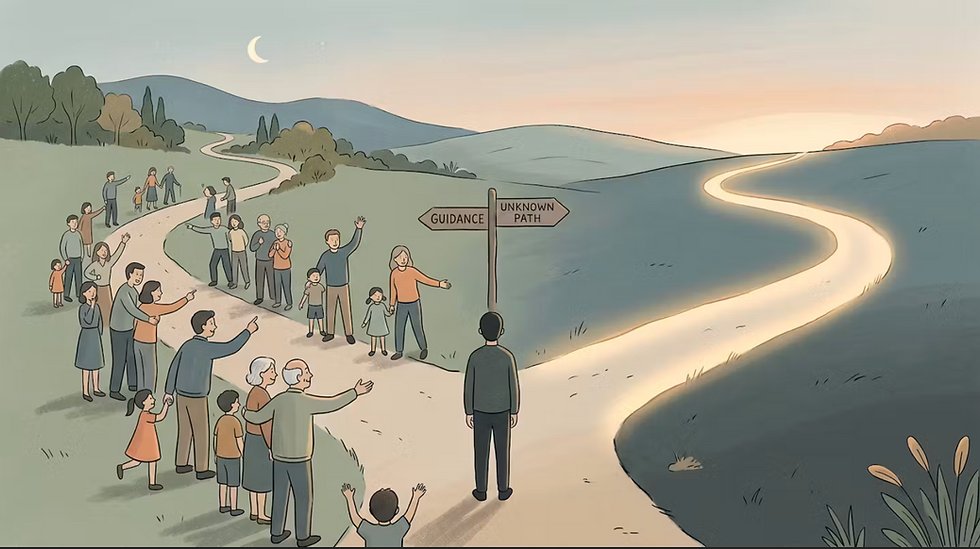
I’m still learning how to live in that tension—
between dependence and awareness,
between speed and depth,
between convenience and genuine thinking.
And I guess I’m still deciding
how much of myself I want to outsource
and how much I want to keep.


Comments